
Background
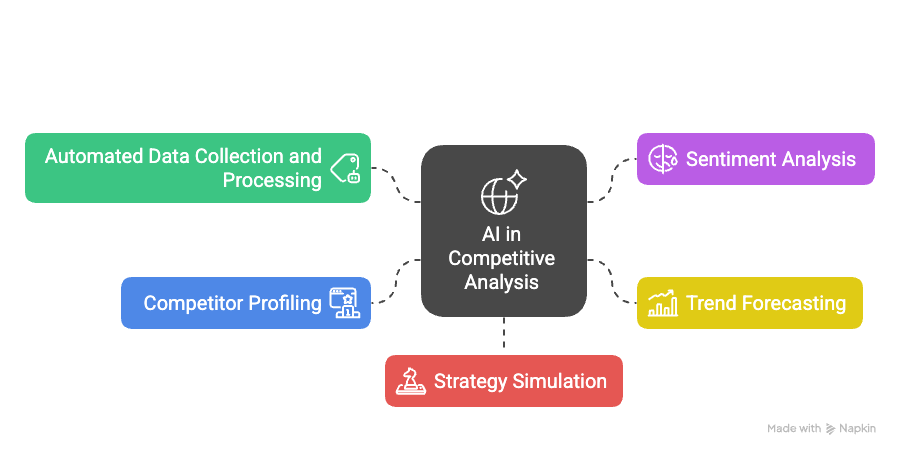
This blog explores the transformative potential of Artificial Intelligence (AI) in competitive analysis. It delves into how AI tools and techniques can enhance traditional methods, providing deeper insights, improved accuracy, and faster response times. We will examine various AI applications, including data collection, sentiment analysis, trend forecasting, and strategy simulation, and discuss the benefits and challenges of integrating AI into competitive intelligence processes.
Introduction
Competitive analysis is a crucial process for businesses to understand their market position, identify opportunities, and mitigate threats. Traditionally, this involves manual data collection, market research, and subjective interpretation. However, the increasing volume and complexity of data, coupled with the need for rapid decision-making, have made traditional methods inadequate. AI offers a powerful solution by automating data collection, extracting meaningful insights, and predicting future trends.
AI Applications in Competitive Analysis
1. Automated Data Collection and Processing
AI-powered tools can automatically collect data from diverse sources, including:
- Web scraping: Extracting data from websites, social media platforms, and online forums.
- News aggregation: Monitoring news articles, press releases, and industry publications.
- Patent databases: Tracking competitor innovations and intellectual property.
- Financial reports: Analyzing competitor financial performance and investment strategies.
AI can also process and clean this data, removing duplicates, correcting errors, and standardizing formats. This significantly reduces the time and effort required for data preparation, allowing analysts to focus on interpretation and strategic decision-making.
2. Sentiment Analysis
Sentiment analysis, also known as opinion mining, uses Natural Language Processing (NLP) to determine the emotional tone expressed in text data. In competitive analysis, sentiment analysis can be used to:
- Monitor customer reviews: Understand customer perceptions of competitor products and services.
- Analyze social media conversations: Track brand mentions, identify trending topics, and gauge public opinion.
- Assess media coverage: Evaluate the tone and sentiment of news articles and blog posts about competitors.
By understanding customer sentiment, businesses can identify areas where competitors are excelling or falling short, and adjust their strategies accordingly.
3. Trend Forecasting
AI algorithms can analyze historical data to identify patterns and predict future trends. This can be applied to:
- Market demand forecasting: Predicting future demand for products and services.
- Technology forecasting: Identifying emerging technologies and their potential impact on the industry.
- Competitor behavior prediction: Anticipating competitor actions, such as product launches, pricing changes, and marketing campaigns.
Accurate trend forecasting allows businesses to proactively adapt to changing market conditions and gain a competitive advantage.
4. Competitor Profiling
AI can create detailed profiles of competitors by analyzing their online presence, marketing materials, financial reports, and other data sources. These profiles can include information on:
- Target market: Identifying the customer segments that competitors are targeting.
- Product portfolio: Analyzing the range of products and services offered by competitors.
- Pricing strategy: Understanding how competitors price their products and services.
- Marketing tactics: Evaluating the marketing channels and messages used by competitors.
- Strengths and weaknesses: Identifying the key advantages and disadvantages of competitors.
Comprehensive competitor profiles provide a valuable foundation for strategic decision-making.
5. Strategy Simulation
AI-powered simulation tools can model different competitive scenarios and predict the outcomes of various strategic decisions. This allows businesses to:
- Test different strategies: Evaluate the potential impact of different marketing campaigns, pricing changes, and product launches.
- Identify optimal strategies: Determine the strategies that are most likely to achieve desired outcomes.
- Assess risk: Evaluate the potential risks associated with different strategies.
Strategy simulation can help businesses make more informed decisions and avoid costly mistakes.
Benefits of AI-Driven Competitive Analysis
- Improved Accuracy: AI algorithms can analyze data more accurately and consistently than humans, reducing the risk of errors and biases.
- Faster Response Times: AI can automate data collection and analysis, allowing businesses to respond quickly to changing market conditions.
- Deeper Insights: AI can identify patterns and relationships in data that humans may miss, providing deeper insights into the competitive landscape.
- Enhanced Efficiency: AI can automate repetitive tasks, freeing up analysts to focus on more strategic activities.
- Data-Driven Decision Making: AI provides objective, data-driven insights that can support more informed decision-making.
Challenges of AI-Driven Competitive Analysis
- Data Quality: AI algorithms are only as good as the data they are trained on. Poor data quality can lead to inaccurate results.
- Algorithm Bias: AI algorithms can be biased if they are trained on biased data. This can lead to unfair or discriminatory outcomes.
- Lack of Transparency: Some AI algorithms are “black boxes,” making it difficult to understand how they arrive at their conclusions.
- Cost: Implementing and maintaining AI systems can be expensive.
- Skills Gap: There is a shortage of skilled professionals who can develop and implement AI solutions.
- Ethical Considerations: The use of AI in competitive analysis raises ethical concerns, such as privacy and data security.
Implementing AI in Competitive Analysis
- Define Objectives: Clearly define the goals of the competitive analysis and identify the key questions that need to be answered.
- Identify Data Sources: Determine the data sources that are relevant to the competitive analysis.
- Select AI Tools: Choose the AI tools and techniques that are best suited to the specific objectives and data sources.
- Data Preparation: Clean and prepare the data for analysis.
- Model Training: Train the AI models on the prepared data.
- Model Evaluation: Evaluate the performance of the AI models and make adjustments as needed.
- Deployment: Deploy the AI models and integrate them into the competitive intelligence process.
- Monitoring and Maintenance: Continuously monitor the performance of the AI models and make updates as needed.
Conclusion
AI offers a powerful set of tools and techniques for enhancing competitive analysis. By automating data collection, extracting meaningful insights, and predicting future trends, AI can help businesses gain a competitive advantage. However, it is important to be aware of the challenges associated with AI and to implement it responsibly. By carefully planning and executing AI initiatives, businesses can unlock the full potential of AI-driven competitive analysis and achieve their strategic goals.