
Background
This blog explores the critical aspects of optimizing data for Artificial Intelligence (AI) applications. It covers key considerations, techniques, and best practices for preparing and transforming data to maximize the performance, accuracy, and reliability of AI models. From data collection and cleaning to feature engineering and data augmentation, this guide provides a comprehensive overview of the data optimization process, enabling organizations to unlock the full potential of their AI initiatives.
1. Data Collection and Preparation
The foundation of any successful AI project lies in the quality and relevance of the data used to train the models. Effective data collection and preparation are crucial steps in ensuring that the AI system learns from a representative and reliable dataset.
1.1. Data Acquisition Strategies
- Internal Data Sources: Leverage existing data within the organization, such as customer databases, transaction logs, and operational records.
- External Data Sources: Supplement internal data with external datasets from public APIs, industry reports, and third-party providers.
- Web Scraping: Extract data from websites using automated tools, ensuring compliance with terms of service and legal regulations.
- Sensor Data: Collect data from sensors and IoT devices to capture real-time information about physical environments and processes.
- User-Generated Content: Utilize data from social media, online forums, and customer reviews to understand user behavior and preferences.
1.2. Data Cleaning and Preprocessing
- Handling Missing Values: Impute missing values using techniques like mean imputation, median imputation, or model-based imputation.
- Removing Duplicates: Identify and remove duplicate records to avoid bias and redundancy in the dataset.
- Correcting Errors: Identify and correct errors in the data, such as typos, inconsistencies, and outliers.
- Data Type Conversion: Convert data types to ensure compatibility with AI algorithms (e.g., converting strings to numerical values).
- Data Formatting: Standardize data formats to ensure consistency and uniformity across the dataset.
1.3. Data Validation and Quality Assurance
- Data Profiling: Analyze data characteristics to identify potential issues and inconsistencies.
- Data Validation Rules: Define and enforce data validation rules to ensure data quality and integrity.
- Data Auditing: Regularly audit data to identify and correct errors or inconsistencies.
- Data Lineage Tracking: Track the origin and transformations of data to ensure transparency and accountability.
2. Feature Engineering
Feature engineering involves selecting, transforming, and creating new features from raw data to improve the performance of AI models. Well-engineered features can significantly enhance the accuracy, interpretability, and generalization ability of AI systems.
2.1. Feature Selection
- Filter Methods: Select features based on statistical measures like correlation, variance, and mutual information.
- Wrapper Methods: Evaluate feature subsets by training and testing AI models on different combinations of features.
- Embedded Methods: Select features as part of the model training process, such as using regularization techniques like L1 regularization.
2.2. Feature Transformation
- Scaling and Normalization: Scale numerical features to a common range to prevent features with larger values from dominating the model.
- Encoding Categorical Variables: Convert categorical variables into numerical representations using techniques like one-hot encoding or label encoding.
- Handling Outliers: Transform or remove outliers to reduce their impact on the model.
- Date and Time Feature Engineering: Extract relevant features from date and time variables, such as day of the week, month, or time of day.
- Text Feature Engineering: Extract features from text data using techniques like TF-IDF, word embeddings, or sentiment analysis.
2.3. Feature Creation
- Polynomial Features: Create new features by raising existing features to higher powers or combining them using polynomial functions.
- Interaction Features: Create new features by combining two or more existing features to capture interactions between them.
- Domain-Specific Features: Create new features based on domain knowledge and expertise to capture relevant information for the specific AI application.
3. Data Augmentation
Data augmentation involves creating new training examples from existing data by applying various transformations. This technique can help to increase the size and diversity of the training dataset, improving the generalization ability of AI models, especially when dealing with limited data.
3.1. Image Data Augmentation
- Rotation: Rotate images by a certain angle.
- Flipping: Flip images horizontally or vertically.
- Scaling: Zoom in or out on images.
- Translation: Shift images horizontally or vertically.
- Shearing: Distort images by shearing them along one axis.
- Color Jittering: Adjust the brightness, contrast, saturation, and hue of images.
3.2. Text Data Augmentation
- Synonym Replacement: Replace words with their synonyms.
- Random Insertion: Insert random words into the text.
- Random Deletion: Delete random words from the text.
- Random Swap: Swap the positions of two random words in the text.
- Back Translation: Translate the text to another language and then back to the original language.
3.3. Audio Data Augmentation
- Time Stretching: Speed up or slow down the audio.
- Pitch Shifting: Change the pitch of the audio.
- Adding Noise: Add random noise to the audio.
- Time Shifting: Shift the audio forward or backward in time.
4. Data Storage and Management
Efficient data storage and management are essential for handling large datasets and ensuring data accessibility, security, and scalability.
4.1. Data Warehousing
- Centralized Data Storage: Store data from various sources in a central repository for analysis and reporting.
- Schema Design: Design a data warehouse schema that is optimized for analytical queries.
- ETL Processes: Implement ETL (Extract, Transform, Load) processes to move data from source systems to the data warehouse.
4.2. Data Lakes
- Flexible Data Storage: Store data in its raw format without predefined schemas.
- Scalable Storage: Use cloud-based storage solutions to handle large volumes of data.
- Data Governance: Implement data governance policies to ensure data quality and security.
4.3. Data Versioning
- Track Data Changes: Track changes to data over time to ensure reproducibility and auditability.
- Version Control Systems: Use version control systems like Git to manage data versions.
- Data Provenance: Capture the lineage of data to understand its origin and transformations.
5. Data Security and Privacy
Protecting data security and privacy is paramount when working with sensitive data. Organizations must implement appropriate security measures and comply with relevant privacy regulations.
5.1. Data Encryption
- Encryption at Rest: Encrypt data when it is stored on disk or in the cloud.
- Encryption in Transit: Encrypt data when it is transmitted over networks.
5.2. Access Control
- Role-Based Access Control: Grant access to data based on user roles and responsibilities.
- Principle of Least Privilege: Grant users only the minimum level of access required to perform their tasks.
5.3. Data Anonymization and Pseudonymization
- Anonymization: Remove personally identifiable information (PII) from data to prevent identification of individuals.
- Pseudonymization: Replace PII with pseudonyms to protect privacy while still allowing for data analysis.
5.4. Compliance with Privacy Regulations
- GDPR: Comply with the General Data Protection Regulation (GDPR) when processing data of EU citizens.
- CCPA: Comply with the California Consumer Privacy Act (CCPA) when processing data of California residents.
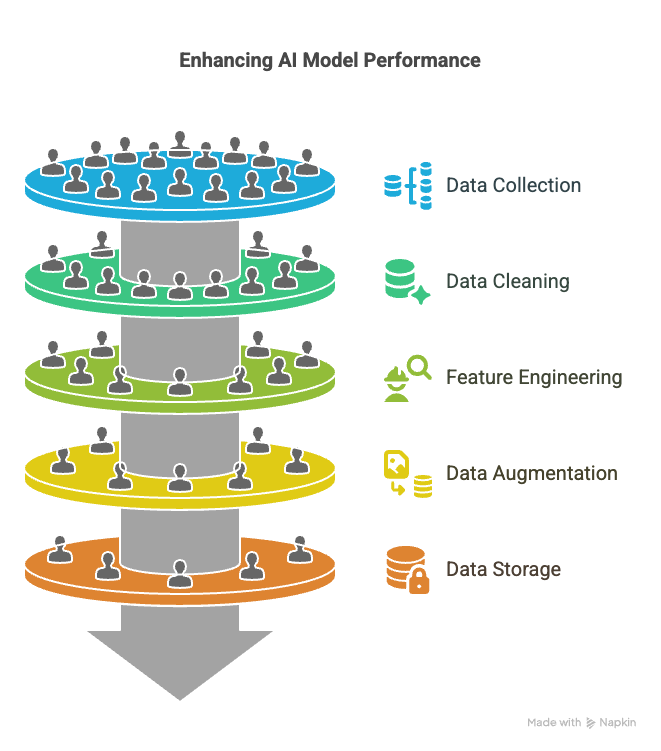
By implementing these data optimization techniques, organizations can significantly improve the performance, accuracy, and reliability of their AI models, unlocking the full potential of their AI initiatives.