
Background
This blog explores the potential of Agentic AI to revolutionize business workflows. It delves into how these intelligent agents can automate complex tasks, improve efficiency, and unlock new levels of productivity. We will examine the core concepts of Agentic AI, its applications in various business domains, and the benefits and challenges associated with its implementation.
What is Agentic AI?
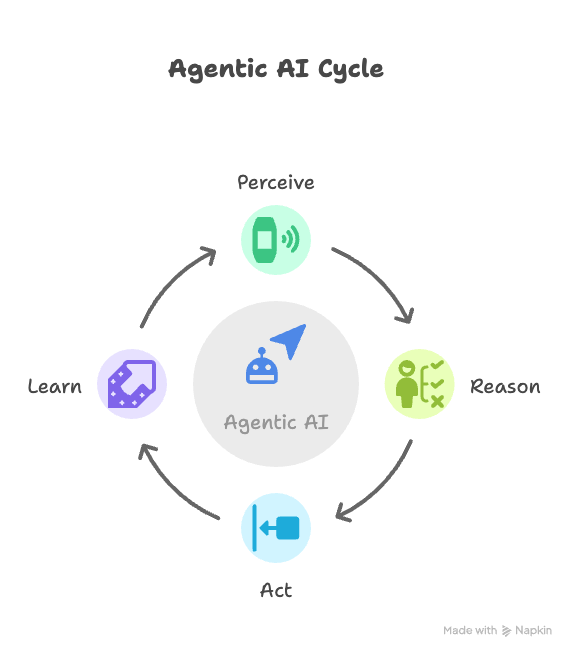
Agentic AI refers to artificial intelligence systems designed to operate autonomously and proactively within a defined environment. Unlike traditional AI, which typically performs specific tasks based on direct instructions, Agentic AI systems can:
- Perceive: Gather information from their environment through sensors or data inputs.
- Reason: Analyze the information and make decisions based on predefined goals and knowledge.
- Act: Execute actions to achieve their goals, adapting their behavior based on feedback and changing circumstances.
- Learn: Improve their performance over time through experience and data analysis
This autonomy allows Agentic AI to handle complex, dynamic tasks that require adaptability and problem-solving skills, making them ideal for automating business workflows.
Applications in Business Workflows
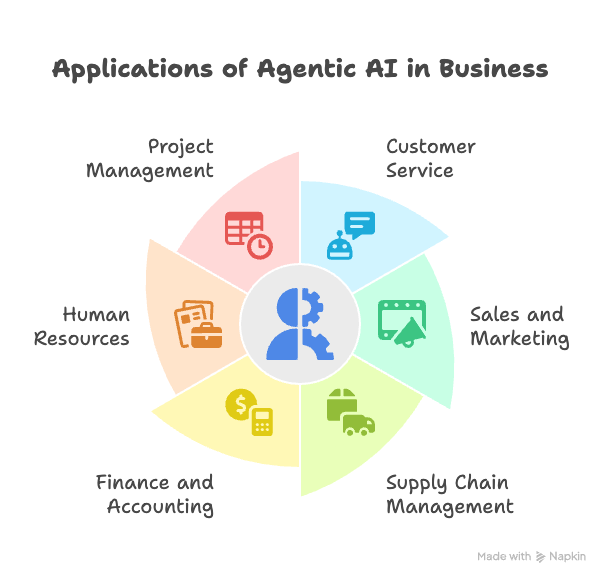
Agentic AI can be applied across a wide range of business functions, including:
- Customer Service: AI agents can handle customer inquiries, resolve issues, and provide personalized support, freeing up human agents for more complex cases.
- Sales and Marketing: Agents can automate lead generation, personalize marketing campaigns, and optimize sales processes.
- Supply Chain Management: AI agents can monitor inventory levels, predict demand, and optimize logistics, ensuring efficient supply chain operations.
- Finance and Accounting: Agents can automate tasks such as invoice processing, reconciliation, and fraud detection.
- Human Resources: AI agents can assist with recruitment, onboarding, and employee training.
- Project Management: Agents can track project progress, identify risks, and allocate resources, ensuring projects are completed on time and within budget.
Benefits of Automating with Agentic AI
Implementing Agentic AI in business workflows offers several key benefits:
- Increased Efficiency: Automation of repetitive tasks frees up human employees to focus on more strategic and creative work.
- Reduced Costs: Automation can significantly reduce labor costs and improve resource utilization.
- Improved Accuracy: AI agents can perform tasks with greater accuracy and consistency than humans, reducing errors and improving quality.
- Enhanced Customer Experience: Personalized and responsive customer service can improve customer satisfaction and loyalty.
- Data-Driven Decision Making: AI agents can collect and analyze data to provide insights that inform better business decisions.
- Scalability: AI agents can easily scale to meet changing business needs, providing flexibility and agility.
Challenges of Implementing Agentic AI
While the potential benefits of Agentic AI are significant, there are also challenges to consider:
- Complexity: Developing and deploying Agentic AI systems can be complex and require specialized expertise.
- Data Requirements: AI agents require large amounts of data to train and operate effectively.
- Ethical Considerations: Ensuring fairness, transparency, and accountability in AI decision-making is crucial.
- Security Risks: Protecting AI systems from cyberattacks and data breaches is essential.
- Integration Challenges: Integrating AI agents with existing systems and workflows can be complex.
- Job Displacement: Automation may lead to job displacement, requiring businesses to invest in retraining and upskilling programs.
Best Practices for Implementation
To successfully implement Agentic AI in business workflows, consider the following best practices:
- Start with a clear understanding of your business goals and objectives.
- Identify specific workflows that can benefit from automation.
- Choose the right AI technology and platform for your needs.
- Develop a comprehensive data strategy.
- Ensure data privacy and security.
- Train your employees on how to work with AI agents.
- Monitor and evaluate the performance of your AI systems.
- Address ethical considerations proactively.
Conclusion
Agentic AI has the potential to transform business workflows by automating complex tasks, improving efficiency, and unlocking new levels of productivity. While there are challenges to consider, the benefits of implementing Agentic AI are significant. By following best practices and addressing ethical considerations, businesses can successfully leverage Agentic AI to achieve their goals and stay ahead of the competition. As the technology continues to evolve, Agentic AI will play an increasingly important role in shaping the future of work.